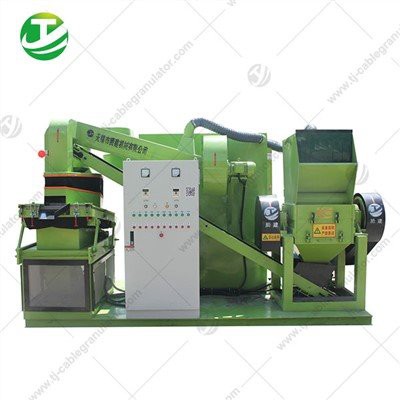
Common Misconceptions About Cable Granulator Machine Maintenance
Feb 18, 2026
I. Misconception 1: Believing "No maintenance needed if there's no problem"
Incorrect Practice: Only checking the machine when it jams, makes abnormal noises, or produces impure output, neglecting preventative maintenance.
Correct Practice: Maintenance should be "prevention-oriented." Even when operating normally, periodic lubrication, tightening, and cleaning are necessary. For example: Lubricate bearings with grease every 150 hours; clean the screen after each shift to prevent clogging that could affect sorting accuracy.
II. Misconception 2: Ignoring seasonal lubrication differences
Incorrect Practice: Using the same lubricant year-round, especially using high-viscosity summer oil in winter, leading to difficulty starting bearings and poor lubrication.
Correct Practice: Adjust lubrication strategies according to temperature: Use high-temperature grease (such as #3 calcium-based grease) in summer; switch to a low-temperature, high-flow grease in winter to avoid dry friction damage.
III. Misconception 3: Delayed Sharpening or Over-reliance on Tool Replacement
Incorrect Practice: Waiting until the tools are completely dull before addressing the issue increases the motor load; or frequently replacing tools wastes resources.
Correct Practice: Sharpen the blades approximately every 10 tons of wire processed to restore sharpness; replace the entire set only when the gap between the moving and stationary blades no longer meets the crushing requirements after repeated sharpening and narrowing.
IV. Misconception 4: Only Cleaning Large Blockages, Ignoring Dust Accumulation
Incorrect Practice: Only cleaning the feed inlet and screen, neglecting dust accumulation in the dust collector, air ducts, and electrical control box.
Correct Practice: Clean the dust collector bags after daily operation to prevent airflow reduction; regularly blow out the electrical control cabinet to avoid short circuits or fire risks caused by dust.
V. Misconception 5: Operating with Power On or Adjusting the Machine by Intuition
Incorrect Practice: Cleaning jammed materials or adjusting the blade distance while the equipment is powered on, for convenience, can easily lead to safety accidents.
Correct Practices: Power must be disconnected before any maintenance operation, and a "Do Not Operate" warning sign must be displayed. Parameter adjustments should be based on evidence; for example, dampers and vibration frequencies should be fine-tuned gradually according to the material output, and valid values should be recorded.
VI. Misconception 6: Neglecting the Importance of Raw Material Pretreatment
Incorrect Practice: Directly feeding mixed iron parts and large wire bundles into the machine can lead to blade breakage and bearing damage.
Correct Practices: Manually sort or install a magnetic separator before feeding to remove metal impurities; Large-diameter cables should be cut or pre-shredded to avoid clogging the feed inlet.