

Can a copper wire separator be used for separating copper from bronze?
May 20, 2025
As a supplier of Copper Wire Separators, I often encounter inquiries regarding the capabilities of our machines, especially in the context of separating copper from various alloys. One question that frequently arises is whether a copper wire separator can be used for separating copper from bronze. In this blog post, I'll delve into the technical aspects of this question, explore the properties of copper and bronze, and discuss the potential use of our copper wire separators in this application.
Understanding Copper and Bronze
Before we discuss the separation process, it's essential to understand the basic properties of copper and bronze. Copper is a chemical element with the symbol Cu and atomic number 29. It is a soft, malleable, and ductile metal with very high thermal and electrical conductivity. Pure copper is often used in electrical wiring, plumbing, and various industrial applications due to its excellent conductivity and corrosion resistance.
Bronze, on the other hand, is an alloy consisting primarily of copper, usually with tin as the main additive. Other elements such as aluminum, manganese, nickel, or zinc may also be present in smaller quantities. The addition of these elements enhances the properties of copper, making bronze harder, stronger, and more resistant to corrosion than pure copper. Bronze has been used for thousands of years in art, sculpture, tools, and various mechanical components.
The Principle of Copper Wire Separators
Copper wire separators are designed to separate copper from other materials, typically insulation materials in scrap copper wires. The basic principle behind these machines involves mechanical processes such as crushing, grinding, and screening to break down the wire into smaller particles and then use physical methods such as air separation or electrostatic separation to separate the copper from the non - metallic components.
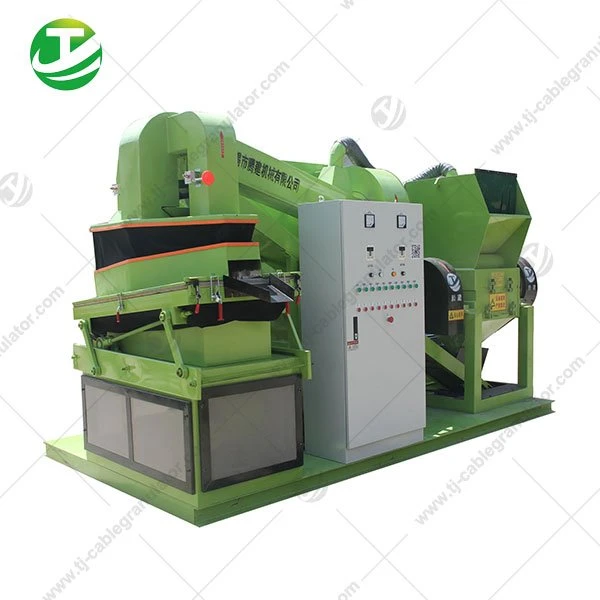

In air separation, the crushed material is blown by air, and the lighter non - metallic particles are carried away by the air stream, while the heavier copper particles fall to the bottom. Electrostatic separation, on the other hand, uses the difference in electrical conductivity between copper and non - metallic materials. When the crushed material passes through an electrostatic field, the copper particles are attracted to the charged electrodes, while the non - metallic particles are repelled.
Can a Copper Wire Separator Separate Copper from Bronze?
The short answer is that a standard copper wire separator is not designed for separating copper from bronze. The reason lies in the nature of bronze as an alloy. Unlike the separation of copper from insulation materials in scrap wires, where the copper and non - metallic materials have distinct physical properties (such as density and electrical conductivity), copper and the alloying elements in bronze are chemically bonded at the atomic level.
In a copper wire separator, the separation is based on physical differences between materials. Since copper and the elements in bronze are mixed at the atomic scale, these physical separation methods are not effective in separating copper from bronze. For example, air separation relies on differences in density, but the density difference between copper and bronze is relatively small, especially when considering the small particle sizes produced by the separator. Similarly, electrostatic separation depends on differences in electrical conductivity, but bronze also has good electrical conductivity due to the high copper content, so it is difficult to distinguish between copper and bronze using this method.
Alternative Methods for Separating Copper from Bronze
If you need to separate copper from bronze, there are other methods available. One common approach is smelting. Smelting involves heating the bronze to a high temperature in the presence of a reducing agent, such as carbon. At high temperatures, the bronze melts, and the reducing agent reacts with the alloying elements, causing them to form oxides or other compounds that can be separated from the molten copper.
Another method is chemical leaching. Chemical leaching uses specific chemicals to dissolve the alloying elements in bronze, leaving the copper behind. For example, certain acids can be used to selectively dissolve tin or other elements in bronze, while copper remains relatively insoluble. However, these methods require specialized equipment and expertise, and they also involve handling hazardous chemicals, so they need to be carried out with proper safety precautions.
Our Product Range and Applications
Although our copper wire separators are not suitable for separating copper from bronze, they are highly effective in other applications. We offer a range of products, including Scrap Cable Recycling Machine, Scrap Copper Wire Granulator Machine, and Small Copper Granulator.
Our scrap cable recycling machines are designed to process large volumes of scrap cables, separating the copper conductors from the insulation materials. These machines are equipped with advanced crushing and separation technologies, ensuring high - efficiency and high - purity copper recovery. The scrap copper wire granulator machines are specifically designed for processing copper wires of various sizes, turning them into high - quality copper granules. Our small copper granulators are ideal for small - scale recycling operations, offering a compact and cost - effective solution for copper wire recycling.
Conclusion
In conclusion, while a copper wire separator is not suitable for separating copper from bronze due to the nature of bronze as an alloy, it is a powerful tool for separating copper from insulation materials in scrap wires. Our range of copper wire separators, including scrap cable recycling machines, scrap copper wire granulator machines, and small copper granulators, can provide efficient and reliable solutions for copper wire recycling.
If you are interested in our products and would like to discuss your specific requirements, please feel free to contact us for further information and to start a procurement negotiation. We are committed to providing high - quality products and excellent customer service to meet your copper wire recycling needs.
References
- "Metals Handbook: Properties and Selection: Nonferrous Alloys and Pure Metals", ASM International.
- "Introduction to Materials Science for Engineers", James F. Shackelford.